Detour
ORIGINALOne of you runs. The other builds the walls. Then you swap.
🎮 1 Player (vs CPU)
Run: ← ↑ ↓ → · Build: WASD + Space · roles swap each leg
👥 2 Players (one keyboard)
Runner: ← ↑ ↓ → · Architect: WASD + Space (or tap the grid)
In-game: P pause · M sound · R restart · Esc menu · pick difficulty on the title screen.
Free · No download · No account · An original game made by TwozyGames.
🎮 About This Game
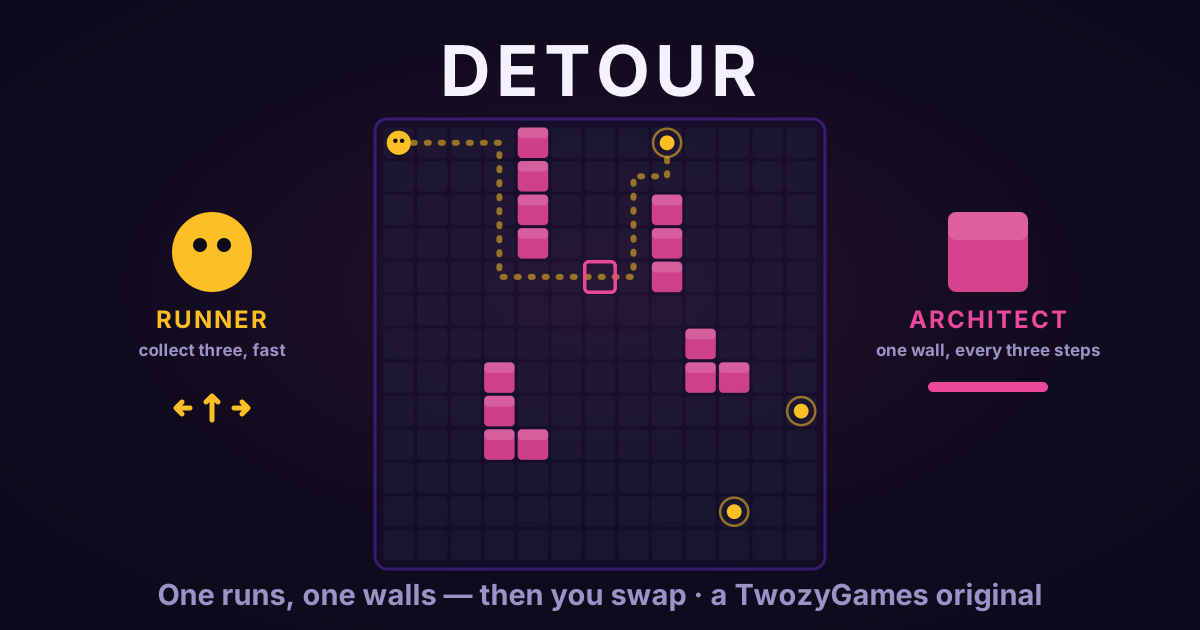
Detour is the asymmetric game in the TwozyGames lineup: the two of you are not playing the same game at all. One is a runner on a thirteen-by-thirteen grid who has to collect three markers as fast as possible. The other never touches the runner and has exactly one verb — drop a wall on the grid, once every second or so. Then you swap, run the identical layout, and whoever was faster takes the round. That swap is the whole design. Most asymmetric games spend their lives being balanced, because one side is always a little stronger than the other; here the sides are measured against each other on the same course by the same two people, so an imbalance cancels rather than needing to be tuned away. There is one rule the architect cannot break: you may cost the runner time, never seal them in. Try to close the last route and the game refuses the wall and says so.
🎯 How to Play
The runner moves with the arrow keys and simply has to touch all three markers; a timer runs from the first frame and that number is the entire score. The architect moves a cursor with WASD and presses Space to place a wall — or just taps the square on a touchscreen, which is the same thing. A bar in the corner shows the cooldown, roughly one wall every three steps the runner takes, so you are choosing where the next wall goes while the runner is still moving through the last one. Walls cannot be placed on the runner's own square, on a marker they have not collected yet, or anywhere that would leave a marker unreachable — that last one is checked properly, on every attempt, and a refused wall does not cost you the cooldown. When the first leg ends, the layout resets to exactly the same markers and the same start, the roles swap, and the second runner is shown the time they have to beat. First to two rounds wins. Solo plays both roles in turn against a CPU that never cheats on speed: the CPU runner moves at exactly the same rate you do, and the CPU architect obeys the same cooldown. Difficulty changes only how well it chooses.
💡 Tips & Strategy
- ▸As the architect, walls only pay if they land on the route the runner is actually taking. A wall dropped somewhere plausible costs a good runner almost nothing — we measured it at about one per cent — while walls placed on their current path cost nearly forty.
- ▸Do not aim at the runner. Aim at the corridor they are about to commit to. By the time a wall appears in front of somebody's nose they are already turning; the wall that hurts is the one two or three squares ahead of where they are looking.
- ▸The three markers are collected in whatever order the runner likes, so think about which one they will go for next and make the cheap route to it expensive. Forcing a re-plan is worth more than adding two squares to a walk.
- ▸As the runner, treat the cooldown bar as your clock. You get roughly three steps between walls, so the moment the bar fills you should already be somewhere the next wall cannot easily hurt you — an open square with two ways out rather than a corridor.
- ▸Runners lose most of their time to backtracking, not to walls. Collect the markers in an order that makes one loop instead of three trips, and you will beat a faster player who chases whichever marker is nearest.
- ▸Remember that the second leg is run on the identical layout, so pay attention while you are the architect: you are learning the map you are about to have to run.
- ▸If you are behind on time in leg two, the aggressive line is usually right — the layout is the same, so you already know roughly where the markers are, and a route you have seen once is cheaper to run than to rediscover.
🛠 From the Devs
This started as a hunter with a vision cone chasing somebody invisible outside it, and that concept is impossible on a shared screen: both players are looking at the same display, so nothing either of them knows can be hidden from the other. Beam had already answered this once — in an asymmetric game on one device the asymmetry has to be one of ability, not knowledge. So the architect is not someone who knows more than the runner, but someone who can do something the runner cannot, in full view. The rest was tuning by measurement. A BFS runner was played against a wall builder four hundred times per configuration: walls dropped carelessly slowed the runner by a factor of 1.01, which is to say by nothing at all, and walls on the runner's live path by 1.39. Placing a wall directly in front of the runner every two steps came out at 2.5 and made the runner helpless, so the shipped cooldown sits at roughly three runner steps. The 1.01 figure is the one that justifies the role existing: if careless walls cost nothing, then everything the architect achieves is skill rather than the mechanic doing it for them.
❓ Frequently Asked Questions
Is Detour fair if one player is much better than the other?
More than most asymmetric games, because you both play both roles on the same course. The round is scored by comparing your run to theirs on an identical layout, so a stronger player being stronger at one role does not decide anything on its own — they have to be better at that role than you are at the same role. It also means the game never needed the two roles to be equally powerful, which is the problem most asymmetric designs spend their whole life managing.
Can the architect trap the runner completely?
No, and it is checked properly rather than approximated. Every wall placement runs a reachability search from the runner to every marker they still need, and if the wall would leave any of them unreachable it is refused, the square flashes red, and you are told why. In our measured runs the rule fires about twice per leg, so it is a real constraint you will bump into rather than a theoretical safeguard.
Does the CPU cheat?
Not on speed. The CPU runner moves at exactly the same rate you do and the CPU architect waits out exactly the same cooldown. Difficulty only changes decision quality: as architect, Easy drops walls anywhere on the grid, Normal puts them somewhere on your shortest path to the nearest marker, and Hard puts them in the first three squares of it. As runner, Hard and Normal always head for the nearest marker while Easy occasionally wanders off to a different one.
Do both legs use the same maze?
Yes, and that is what makes the comparison mean anything. Both legs of a round start from the same corner with the markers in the same three places; the only difference between the two runs is where each architect chose to put their walls. It also means the architect is scouting: you are looking at the layout you are about to have to run yourself.
More original games





📖 Related Guides
 Guide
GuideDetour Strategy Guide: How to Build Walls That Actually Cost Time
The complete strategy guide to Detour, written by the people who coded it: the measurement that says a careless wall costs the runner nothing at all, where the wall that hurts actually goes, why the seal rule fires about twice a leg, exactly what each CPU difficulty does, and the routing habit that beats a faster opponent.
Read more → Picks
PicksTop 10 Best 2 Player Browser Games to Play With Friends in 2026
No downloads needed — the 10 best 2 player browser games for 2026, hand-picked for couch co-op and same-keyboard sessions. Play instantly in your browser.
Read more → Picks
Picks5 Best Browser Games for Couples — Date Night at Home
Low-pressure co-op, chill dice nights, and light competitive duels — 5 browser games that make date night at home feel effortless.
Read more →