Tilt
ORIGINALDrop a stone, or turn the whole board and watch every stone fall somewhere new.
🎮 1 Player (vs CPU)
Lane: ← → · Drop: Space · Tilt: Q / E, press again to play it
👥 2 Players (one keyboard)
Both share: ← → lane · Space drop · Q / E tilt
In-game: P pause · M sound · R restart · Esc menu · pick difficulty on the title screen.
Free · No download · No account · An original game made by TwozyGames.
🎮 About This Game
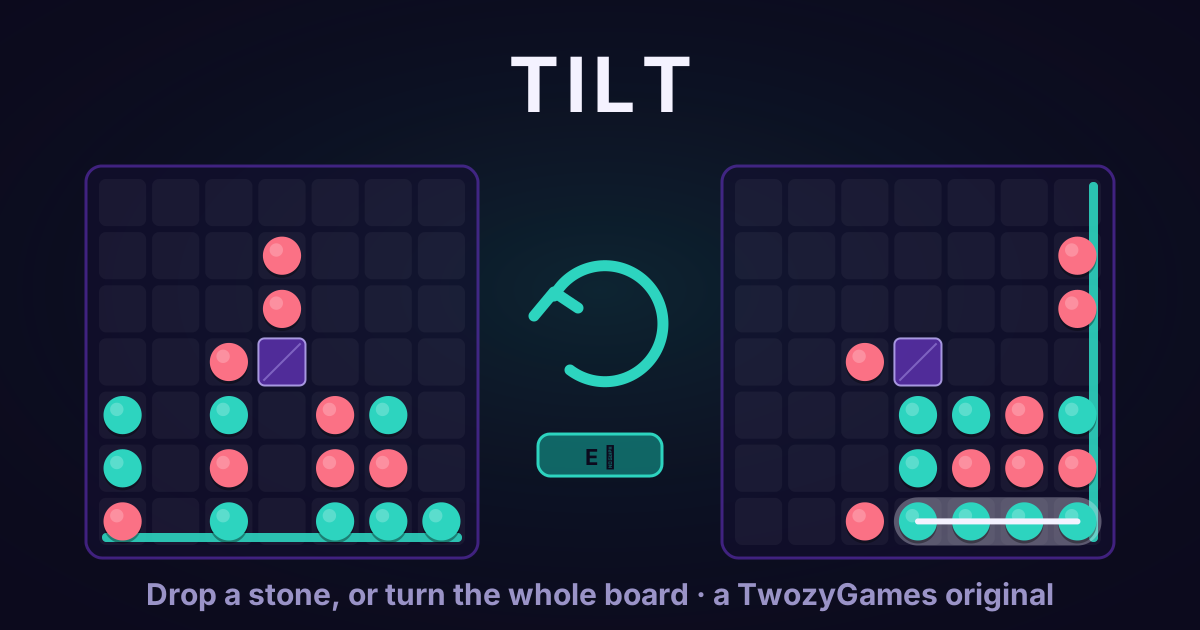
Tilt is the first turn-based game in the TwozyGames lineup, and the first board game we have built. The board is seven by seven, four in a row wins the round, and on your turn you get exactly one decision: drop a stone into a lane, or tilt the whole board a quarter turn so that every stone already on it pours into the new down. Tilting costs you your stone for that turn, which is what makes it a real choice rather than a free extra. Nothing you build is permanently yours, because the shape you spent four turns assembling is one tilt away from being somebody else's problem — or somebody else's line. Five boards change the geometry: from a completely open grid up to four fixed posts that split the lanes into segments, so stones stack against a post exactly as they stack against a wall. Matches are the best of three rounds, and the round after this one starts with the other player.
🎯 How to Play
Both players share one set of controls, because only one of you is ever to move. Use the left and right arrows to pick a lane and Space to drop your stone into it — or tap the lane directly, which is the same move. Q tilts the board anticlockwise and E tilts it clockwise, and each of those is two presses, not one: the first press shows you the board you would get, with every stone drawn as a dashed ghost where it would land and a dashed bar along the edge that would become the new floor. Press the same key again to commit to it, press the other key to look at the other direction instead, or make any other move to throw the preview away. The bright bar hugging one inside edge of the board is the current floor, which is the thing to keep an eye on: a lane is only open if the cell it enters through is free, so turning the board changes which lanes you can even play into. Four of your own stones in a row in any direction ends the round, and if a single move happens to complete a line for both players, the round goes to whoever made the move. Fill the board with no line anywhere and the round is a draw, which the simulation puts at under one percent of games. First to two rounds takes the match.
💡 Tips & Strategy
- ▸Read every shape you build twice: once as it stands, and once as it will be after the board turns a quarter. A vertical three that looks like a threat becomes a horizontal three somewhere else entirely, and it may not be yours to finish.
- ▸Preview both directions before you tilt. That is what the second press is for — arming one direction does not play it, so you can arm the left one, look, arm the right one, look at that, and only then commit.
- ▸A tilt costs you a stone, so it has to buy more than a tidier board. The usual reason to spend one is that your opponent has a line they can complete next turn and the turn scatters it.
- ▸The floor bar is not decoration. When it moves, so does the set of lanes you are allowed to drop into, and the lane you were counting on may be walled off by a post or a stack that just slid across it.
- ▸On the boards with posts, a post is a second wall in the middle of the grid. Stones settle against it in segments, so you can park a stone in the middle of a lane rather than always at the far end — that is the whole reason the posted boards play differently.
- ▸Watch out for tilting into your opponent's line rather than out of your own. The stones do not care whose they are, and gravity is applied to the whole board at once.
- ▸The starting player alternates every round, so a match cannot be decided by who moved first. Over the measured runs the opening seat is worth about five points of win rate in a single round and nothing at all across a match.
🛠 From the Devs
The rules here were chosen by measurement rather than by feel, and the first version of the idea did not survive it. Tilt started as a game with one verb — you drop a stone, and gravity rotates automatically every turn. A headless simulation with a two-ply bot on both sides, thousands of games per configuration, was written before a single line of the game existed, and it scored that version at 74 to 79 percent for whoever moved first, with games over in around ten moves. No board size rescued it and larger boards were worse. Letting the player choose between dropping and tilting brought it to roughly 52 against 47 with well under one percent draws and thirty-odd moves a game. Connect five and an eight-by-eight board were rejected on the same evidence — twenty-seven percent draws and seventy-move games respectively — and a cooldown on tilting was dropped because it moved the balance by less than a point and was one more rule to explain. The first playtest came back saying it felt a bit simple, which sent us to the numbers again: a two-ply bot beats a greedy one about ninety percent of the time under every rule variant tried, so depth was never the missing thing. What was missing was that every round opened on the same empty grid. The answer was boards, not mechanics, and tilting became two-way at the same time — which took the bots from tilting on twelve percent of their moves to twenty-two.
❓ Frequently Asked Questions
How is Tilt different from Connect Four?
The board turns. In Connect Four gravity points one way forever, so a stone you drop is where it stays and the position only ever grows. Here a quarter turn re-settles every stone on the board at once, so positions get taken apart as often as they get built, and half of your reading is about what your own shapes become after somebody rotates them.
Does tilting cost me anything?
Your turn. A tilt is instead of a drop, never as well as one, which is what stops the board from spinning constantly. Our bots find it worth paying on roughly one move in five.
What are the posts on some of the boards?
Fixed blocks that never move and that stones cannot occupy. They matter because a lane containing a post settles in two pieces rather than one, so stones can come to rest in the middle of the grid instead of always piling at the far edge. The five boards run from a completely open grid to four posts in the corners.
Can I play Tilt on a phone with a friend?
Yes, and this is the one original that needs no on-screen joysticks at all. It is turn-based, so two people can pass a single phone and take turns tapping — tap a lane to drop, tap a tilt button to preview it, tap the same button again to commit.
More original games
📖 Related Guides
 Guide
GuideTilt Strategy Guide: When to Turn the Board, and What the CPU Cannot See
The complete strategy guide to Tilt, written by the people who coded it: why a tilt is worth exactly one stone, how to read a shape twice, the exact search depth of each CPU difficulty and the two-move threat it is blind to, the one-line rule that decides shared lines, and how each of the five boards changes the game.
Read more → Picks
PicksTop 10 Free Puzzle Games to Play in Your Browser (2026)
Sudoku, match-3 fighters, jigsaw hybrids, and more — the 10 best free browser puzzle games for 2026, hand-picked for both phone and desktop play.
Read more → Guide
GuideSame-Keyboard Multiplayer — How to Play 2 Player Browser Games on One PC
One keyboard, two players, zero setup. Full guide to same-keyboard 2-player browser gaming — controls, ergonomics, troubleshooting stuck keys, and recommended titles.
Read more →