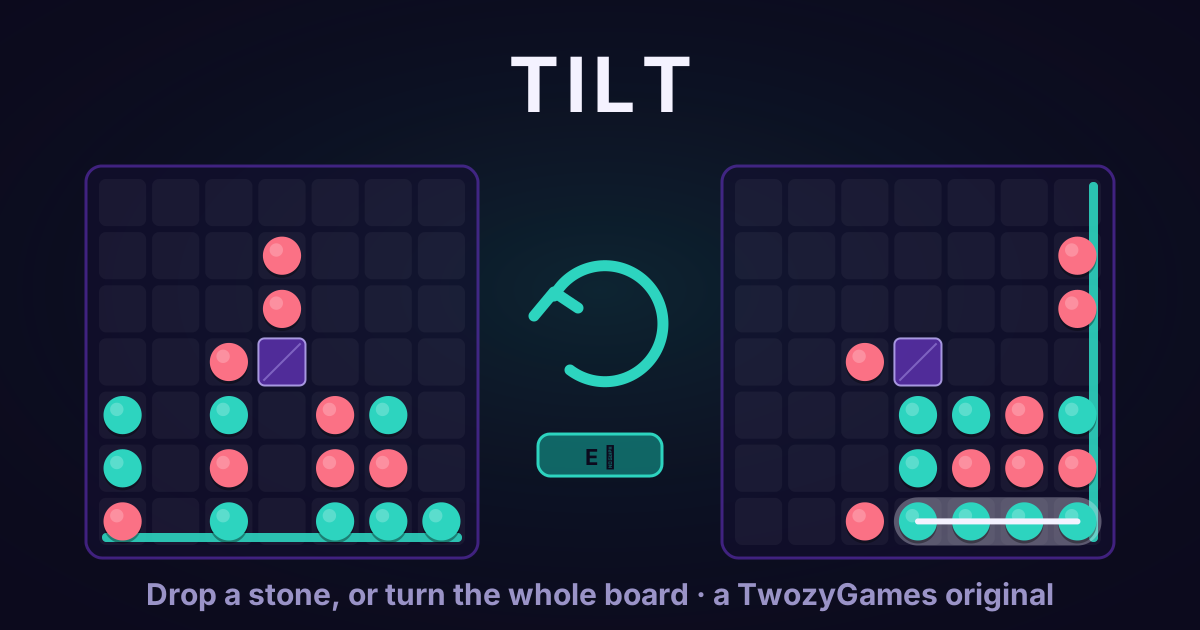
Tilt is the first turn-based game in the TwozyGames Originals lineup, and the one that people underestimate on sight. It looks like Connect Four on a bigger grid. It is not, and the difference is one verb: on your turn you may drop a stone into a lane, or turn the whole board a quarter and let every stone already on it pour into the new down. We wrote the code and the simulation that chose the rules, so this guide can give you the actual numbers — including the exact depth each CPU searches to, and the shape of threat it is structurally unable to see.
A tilt costs exactly one stone
This is the whole economy of the game. A tilt is played instead of a drop, never as well as one, so every turn you spend rotating is a stone your opponent gets for free. That single constraint is what stops the board from spinning forever, and it is why "should I tilt?" is a real question rather than a reflex.
So a tilt has to buy more than a tidier board. In practice there are three purchases worth the stone:
- Demolition. Your opponent has three in a row and a lane to finish it next turn. A quarter turn re-settles every stone at once, and their three usually stops being three.
- Delivery. Your own scattered stones happen to line up along the axis the new gravity will pull them down. This is the move that wins games, and it is the one beginners never look for, because it requires reading a shape that does not exist yet.
- Lane denial. A lane is open only if the cell it enters through is free. Turning the board changes which entry cells are covered, so a tilt can close the exact lane your opponent needed — a quieter play than the other two and often the cheapest.
Our bots, playing thousands of games against each other, spend a turn on a tilt in 21 to 25 per cent of their moves depending on the board. Roughly one move in four or five. If you are tilting much more than that you are donating stones; much less and you are playing Connect Four on a board that does not reward it.
Read every shape twice
The single habit that separates people who win at Tilt from people who lose it: read the board as it is, then read it as it will be after a quarter turn. Your vertical three becomes a horizontal three somewhere else entirely, and — this is the part that stings — it may land where your opponent, not you, has the open lane to finish it.
The practical version of that habit is to stop thinking of your stones as being in a place and start thinking of them as being in an order. Gravity preserves order within a lane; it only changes which end of the lane the pile rests against. Two of your stones adjacent in a column stay adjacent after the turn. Two separated by a gap collapse together. That is the entire physics, and once you can see it you can plan a line that only assembles itself after somebody rotates.
The preview is two presses, and that is a licence to compare
Press Q or E once and nothing is played. You get a ghost board: every stone drawn dashed exactly where it would land, plus a dashed bar along the edge that would become the new floor. Press the same key again to commit it. Press the other key and you are now looking at the other direction instead. Any other move throws the preview away.
This is deliberate, and it was not the first design — the original build previewed while you held the key and played the tilt when you let go, which meant looking was doing. You could never peek and back out, and you certainly could not compare the two directions, because previewing one had already played it. A preview you cannot cancel is not a preview. So use what the fix bought you: arm anticlockwise, look, arm clockwise, look at that, then decide. It costs nothing, and the two directions of a tilt are almost never equally good.
What each CPU can and cannot see
The opponent you play against is the same code that ran the balance simulation, so we can just tell you what it does.
- Easy picks uniformly at random from every legal move, tilts included. It is genuinely random, not a weakened searcher, so it will occasionally stumble into a good tilt and occasionally hand you the game.
- Normal looks exactly one move deep. It plays a winning move if it has one, otherwise it avoids any move that immediately hands you a win, and picks at random among what is left. It will never walk into a one-move loss, and it will never see anything further.
- Hard looks two moves deep. Of its safe moves, it prefers those whose worst single reply from you is not a loss.
That last line is the exploitable one, and it is worth being precise about. Hard is a two-ply search. It sees "if I play this, can you win immediately?" — and then it stops. It does not see a position where you make a quiet move, it answers, and then you win. So the way to beat Hard is not to out-calculate it; it is to build threats that need two of your moves to mature. A drop that creates two separate three-in-a-rows, or a stone placed so that either direction of tilt gives you a line, both fall outside its horizon: whichever reply it makes, it is losing to the other one, and it cannot see that when it chooses.
For scale: across every rule variant we tested, a two-ply bot beat a one-ply greedy bot around 84 to 88 per cent of the time. Playing well matters a great deal in this game. It just does not have to matter more than two moves at a time to beat the machine.
Ties go to whoever moved
One line in the rules, and it decides a real fraction of close games. If a single move completes a four for both players — which a tilt can easily do, since it re-settles the whole board at once — the round goes to the player who made the move.
The practical consequence: when the board is dense and both of you have loose threes lying around, being the one who pulls the trigger is worth more than the position is. If you can see a tilt that gives you both a line, take it; if you can see one that gives you both a line and you are not to move, do not create the conditions for your opponent to play it. Our simulation puts this case under a tenth of a per cent of games, which is why it is stated as one sentence rather than built into a mechanic — but when it comes up it is the whole round.
The five boards
Press S on the title screen to cycle them. The posts are fixed blocks that never move and that stones cannot occupy, and the reason they matter is not that they take up space: a lane containing a post settles in two pieces instead of one. Stones pile against a post exactly as they pile against a wall, so a post lets you park a stone in the middle of the grid rather than always at the far edge.
- Open — no posts. The purest version, and the one where tilts are most violent, because nothing anchors anything. Best board to learn the reading habit on.
- Pillar — one post dead centre. It cuts the two middle lanes in half, which quietly makes the centre of the board the most contested real estate, the way it is in most connection games.
- Pillars — two posts on a diagonal. Creates two independent stacking zones per axis; lines that cross the diagonal are hard to keep, lines that run alongside it are surprisingly stable.
- Slash — three posts on a diagonal. The most structured board. Diagonal fours are much easier here than you expect, because the posts hold stones at heights that a clean grid never would.
- Corners — four posts, one near each corner. Our bots tilt most often on this board (about a quarter of all moves), because the corner pockets make the effect of a rotation the least predictable.
What we measured
Every rule in Tilt was chosen from a headless simulation — two-ply bots on both sides, 1,200 games per board — that was written before any of the game existed. The numbers it produced for the shipped rules, across the five boards:
- First player wins 51.4 to 53.2 per cent, second player 45.9 to 47.8. Rounds alternate the starting player, so that residual edge cancels out across a match.
- Draws: 0.3 to 1.0 per cent. Filling a 7×7 board without a four in it almost never happens.
- Game length: 32.7 to 34.2 moves.
Some things that did not ship, and why. The original concept had no choice in it at all — you drop, and gravity rotates automatically every turn. That version scored 74 to 79 per cent for whoever moved first, in games that ended in about ten moves, and no board size rescued it. Connect five drew 26.9 per cent of the time; an 8×8 board ran to sixty moves. A cooldown between tilts moved the balance by less than a point, so it was deleted for being a rule that had to be explained and paid for nothing.
Two people, one phone
Tilt is the only game in our lineup with no on-screen joysticks, and that is a consequence of being turn-based rather than a feature we added. Only one of you is ever to move, so both players share a single control set and there is nothing to split. Two people can pass one phone across a table: tap a lane to drop, tap a tilt button to preview it, tap the same button again to play it. If that is the way you usually play, our guide to same-keyboard two-player games covers the rest of the lineup, and the puzzle picks are the closest neighbours in the catalogue.
Start with Open on Normal until reading a rotated board stops feeling like work. Then move to Corners on Hard and go hunting for the two-move threat.