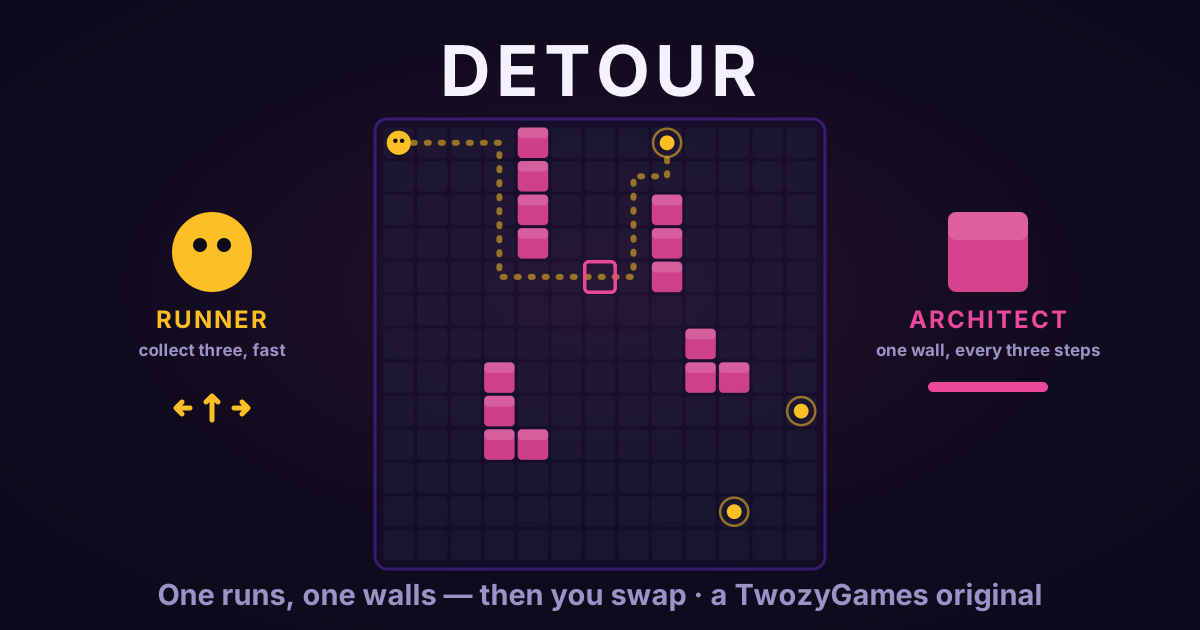
Detour is the asymmetric game in the TwozyGames Originals lineup, and the only one where the two players do not share a verb. One runs a thirteen-by-thirteen grid collecting three markers against a clock. The other cannot touch the runner at all and can only drop a wall, about once a second. Then you swap and run the identical layout, and the faster time takes the round. We wrote the code and the simulation that set the numbers, so this guide can tell you exactly how much a wall is worth — and the answer, for most of the walls people place, is nothing.
The number that should change how you build
Before the game existed we played a pathfinding runner against a wall builder, four hundred runs per configuration. Two results matter:
- Walls dropped anywhere plausible: 1.01×. That is not a small effect, it is no effect. A good runner routes around a wall that is not on their line without losing measurable time.
- Walls dropped on the route the runner is actually taking: 1.39×. Nearly forty per cent slower.
Almost all the value in the architect role is in the gap between those two numbers, and almost every new player spends their first leg on the wrong side of it — building a fence somewhere sensible-looking, watching the runner stroll past it, and concluding the role is weak. It is not weak. It is precise.
The reason we kept that 1.01 rather than tuning it away is that it is the argument for the role existing at all. If careless walls cost real time, the architect would be getting results from the mechanic rather than from play. Because they cost nothing, everything you achieve as the architect is yours.
Where the wall goes
Not on the runner. By the time a wall appears directly in front of somebody, they are already turning into the gap beside it — you have spent your cooldown to make them lose about a step. The wall that hurts is the one two or three squares ahead of where the runner is looking, on the corridor they have already committed to.
Better still, think about which marker they are heading for rather than which square they are on. A runner picks a target and walks to it, so the expensive thing you can do is make the cheap route to that target stop being the cheap route. Force a re-plan and you buy several seconds; add two squares to a walk and you buy half of one.
Corners are where this pays best. A wall placed where two corridors meet takes options away from a route that has not been chosen yet, which is worth more than blocking a route that has.
You cannot seal them in, and you will find that out
There is exactly one rule the architect has to obey: you may cost the runner time, never lock them out. Every time you place a wall, the game runs a reachability search from the runner to every marker they still need. If your wall would leave any of them unreachable, it is refused, the square flashes red, and it tells you why.
This is not a rare theoretical guard. In the measured runs it fires about twice per leg, which means it is a constraint you will bump into on purpose once you get good — the strongest walls are the ones that come closest to being illegal. Useful detail: a refused wall does not consume your cooldown, so probing the edge of the rule is free. If you think a square might be the last route, try it. Either it works or you learn something and lose nothing.
Running: the clock in the corner is yours too
Runners tend to watch the markers and ignore the cooldown bar, which is a mistake — that bar tells you exactly when the next wall can appear. You get roughly three steps between walls. Use them: the moment the bar fills, you want to be somewhere a wall cannot cost you much, which means an open square with two ways out rather than the middle of a corridor.
The bigger win, though, is routing. Most of the time a runner loses is not spent walking into walls, it is spent backtracking. The three markers can be collected in any order, so plan a loop rather than three separate trips out and back. A player who always chases whichever marker is nearest right now will lose to a slower player who picked an order — and the CPU on Hard and Normal is exactly that nearest-first player, which is the seam to exploit when you are behind.
And when you are behind on time in leg two, take the aggressive line. The layout is identical, so you already know roughly where the markers are; a route you have seen is cheaper to run than one you have to discover.
What the CPU actually does
It does not cheat on speed. The CPU runner moves at exactly the rate you do and the CPU architect waits out exactly the same cooldown. Only decision quality changes:
- As architect — Easy drops a wall anywhere on the grid, which by the numbers above means it is barely playing. Normal puts one somewhere along your shortest path to the nearest marker. Hard puts one in the first three squares of that path.
- As runner — Normal and Hard always head for the nearest remaining marker. Easy takes a different one about a quarter of the time.
So Hard as an opponent architect is aggressive and close-range, and the counter is to break its assumption: it re-computes your shortest path to the nearest marker, so committing to a slightly longer route to a different marker sends its walls somewhere you are not going.
Why the roles swap
Asymmetric games usually spend their whole lives being balanced, because one side is always a little stronger. Detour does not have to. You both play both roles on the same course, and the round is decided by comparing your run to theirs — so if the architect happens to be the stronger seat, it is the stronger seat for both of you and it cancels. That is the reason the format is two legs on an identical layout rather than one leg and a handicap.
It also means the architect leg is reconnaissance. You are looking at the layout you are about to have to run, and if you are paying attention while you build, you start leg two already knowing the map.
One more thing about the concept
Detour started as a hunter with a vision cone chasing someone invisible outside it, and that idea cannot work on a shared screen: both players are looking at the same display, so nothing either of them knows can be hidden from the other. Beam had already run into this and answered it — in an asymmetric game on one device, the asymmetry has to be one of ability, not knowledge. The architect does not know more than the runner. They can do something the runner cannot, in full view, and that turns out to be enough.
If you like this shape, the rest of our two-player lineup is covered in the 2-player picks, and Tilt is the deliberate opposite — turn-based, and both players share one set of keys.