Fulcrum
ORIGINALYou both build the same beam. It only falls on one of you.
🎮 1 Player (vs CPU)
Slot: ← → · Swap block: ↑ ↓ · Place: Space (or tap)
👥 2 Players (one keyboard)
Both share: ← → slot · ↑ ↓ swap block · Space place
In-game: P pause · M sound · R restart · Esc menu · pick difficulty on the title screen.
Free · No download · No account · An original game made by TwozyGames.
🎮 About This Game
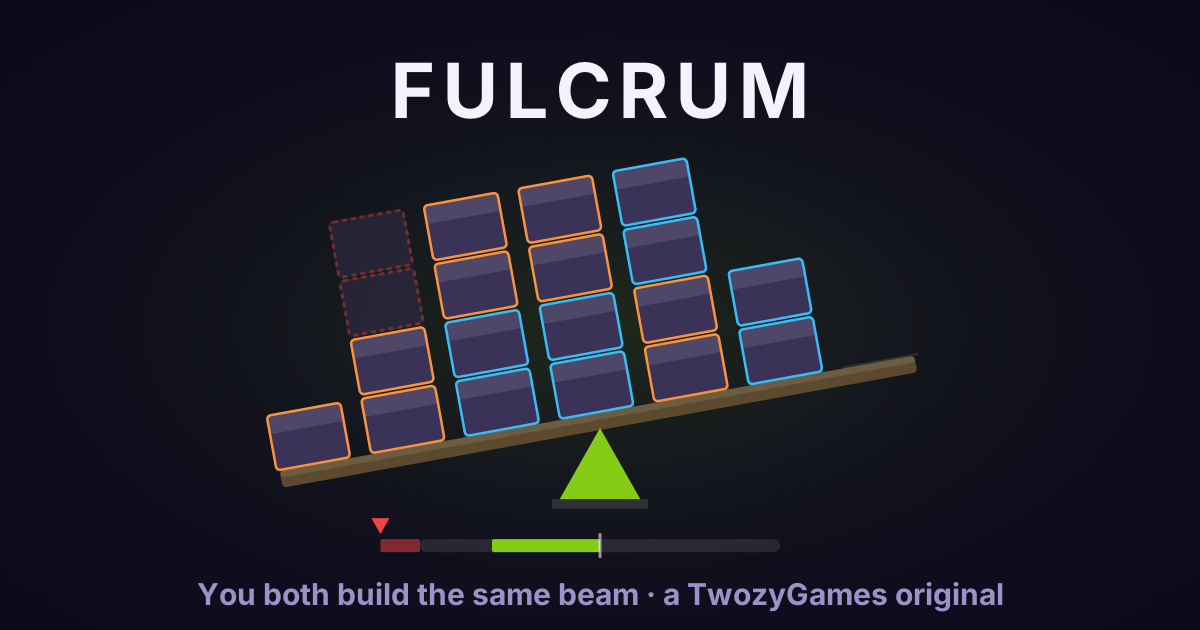
Fulcrum is a balance duel that the two of you build together. A beam sits on a single pivot with seven slots along it, and on your turn you place one block into one of them. Blocks come in two sizes, you always have a hand of two to choose between, and stacks can go four high. The beam leans in proportion to the weight either side of the pivot, and the moment your own placement pushes it past its limit, it goes over and you lose the round. That last part is the whole game: there is one beam, both players build it, and it only ever falls on the person who placed the last block. Everything you add is also something your opponent gets to build on. The other way to lose is quieter and, between evenly matched players, very nearly as common — the board has twenty-eight units of room in total, and if nothing in your hand fits anywhere, you are out of moves and the round is yours to lose. So the beam is not really the constraint. Room is. First to two rounds takes the match, and the player who opens alternates each round.
🎯 How to Play
Both players share one control set, because only one of you is ever to move. The left and right arrows pick a slot, the up and down arrows swap between the two blocks in your hand, and Space drops the selected block — or just tap the slot, which is the same move. Two readouts tell you everything you need before you commit. The ghost block shows where your piece will land, and it turns red if placing it there would tip the beam. Below the board, a meter shows the current lean with a tick marking exactly where this placement would leave it; if the tick sits past the end of the bar, that move loses on the spot. Both are worth trusting over the beam itself, because a beam that looks alarming can still be legal and a beam that looks fine can be one block from gone. Watch for the outer slots in particular: they sit three units from the pivot, so a size-two block out there is six against a limit of five — on an empty beam, that is a loss on move one. Solo plays against a CPU that gets no extra information and no extra moves, only better judgement. Easy places legally at random, Normal always takes the move that leaves the beam most level, and Hard looks one move ahead and picks the placement that leaves you the fewest safe replies, averaged over both blocks you might draw.
💡 Tips & Strategy
- ▸Do not mirror your opponent. Answering every block with its reflection on the other side keeps the beam perfectly level and loses anyway — we measured a mirroring player at 33% against one that simply keeps things level. It feels safe because it is safe, and safe is not the same as winning.
- ▸Do not hoard the centre either. The middle slot applies no torque at all, so it is tempting to treat it as free room, but a player who always takes the flattest slot available also wins only about 33%. The centre is four units of the cheapest space on the board, and spending it early leaves you nothing to correct a lean with later.
- ▸Count room, not weight. Between two players who both keep the beam level, roughly half of all rounds end with somebody having no legal move rather than with the beam going over. The stronger you both play, the more it tilts that way — the CPU on Hard wins over nine tenths of its games by leaving you stuck, not by making you topple.
- ▸That makes the size-two block a resource, not a burden. It eats two units of a stack and applies twice the torque, so dumping it costs you room twice as fast. Playing your ones and holding a two is often how you end up as the player who still has a move.
- ▸Look at the tick on the meter, not at the beam. The lean is proportional, so the difference between a legal placement and a losing one can be a couple of pixels of rotation, and the preview tick states it exactly.
- ▸Filling an outer slot to its full height takes the strongest lever on the board out of play for both of you. If you are ahead on room, that is a good trade; if you are behind, you have just removed your own best tool for making the beam awkward.
- ▸Remember that the beam only falls on whoever touched it last. Leaving the board balanced but nearly full is not generosity, it is the strongest position in the game — your opponent has to find a legal move, and every one of them makes the next one harder.
🛠 From the Devs
The rules here were chosen by exact solve before the game existed, and two designs died on the way. A plain beam with one block per slot turned out to be shallow: the position is a single number, so the obvious move is nearly always the right one, and perfect play beat a keep-it-level bot only 41-57%. Stacking fixed the depth by adding a constraint that pulls the other way — staying level means reusing the middle, and reusing the middle is what fills a stack — but introduced a worse problem. A perfect player never topples, so the game collapsed into fill the capacity, whoever cannot move loses, and capacity is a fixed number. Its parity decided the game before anybody moved, and measured openings of 99%, 4% and 98% matched that prediction exactly. One pile of Nim wearing a costume. The fix had to make the number of moves vary. Drawing a random block size does that and makes the opening fair, but luck then dilutes skill down to 61%. Letting players choose their size freely restores skill to 93% and makes the game deterministic and solved again, back to 0% or 100% openings. A hand of two gets both at once: the draw keeps the position out of reach of a solved line, and the choice keeps spending capacity a decision. Shipped, it opens at 50.1%, perfect play beats keep-it-level 70.3%, and keep-it-level beats random 90.7%. One assumption I opened with was simply wrong, which is why the mirroring bot went into the tournament instead of being designed around: mirroring across the fulcrum does not draw forever, it loses.
❓ Frequently Asked Questions
How do you actually lose a round?
Two ways, and both are on you rather than on your opponent. Either your own placement pushes the beam past its tipping point, or you reach your turn and nothing in your hand fits anywhere on the board. Between evenly matched players those two are close to an even split, so treating Fulcrum purely as a balance game is a good way to lose the other half of the time. Note that the beam only ever falls on the player who placed the last block — an already-alarming beam that you did not tip is not your problem yet.
Is going first an advantage?
No, and that took some work. The stacking version of this game was decided by whether the total capacity was odd or even, which meant the seat you sat in settled the round before a block was placed. Giving blocks two sizes and a hand to choose from makes the number of moves vary, which puts the game out of reach of that parity line; the shipped rules measure at 50.1% for the opening seat. The player who opens also alternates every round, so the match cannot turn on it either way.
Does the CPU cheat?
No. It sees the same board and draws from the same pile, and it never gets an extra placement. Difficulty is only decision quality: Easy picks at random among legal moves, Normal takes whichever legal move leaves the beam closest to level, and Hard looks one move ahead, counting how many safe replies each of its options would leave you with across both blocks you might draw, and picks the one that leaves you fewest. Hard is a one-move-deep heuristic rather than perfect play, so it is beatable — perfect play would be a good deal harder.
Why is the middle slot not just the best move every time?
Because torque is not the only thing you are spending. The centre applies no torque, so it never brings you closer to tipping, but it is still four units of a twenty-eight unit board and it is the most valuable four because they are the ones that cost you nothing. A player who always grabs the flattest available slot wins about a third of their games against a player who thinks about balance and room together. The centre is best understood as the move you save for when the beam has already been pulled somewhere awkward.
More original games
📖 Related Guides
 Guide
GuideFulcrum Strategy Guide: Why the Beam Is Not What Beats You
The complete strategy guide to Fulcrum, written by the people who coded it: the measurement showing that strong players lose by running out of room rather than by tipping the beam, why mirroring your opponent and hogging the centre both lose about two thirds of the time, the one placement that loses on move one, and exactly what each CPU difficulty does.
Read more → Guide
GuideTilt Strategy Guide: When to Turn the Board, and What the CPU Cannot See
The complete strategy guide to Tilt, written by the people who coded it: why a tilt is worth exactly one stone, how to read a shape twice, the exact search depth of each CPU difficulty and the two-move threat it is blind to, the one-line rule that decides shared lines, and how each of the five boards changes the game.
Read more → Picks
PicksTwozyGames Originals: Free 2-Player Browser Games We Built Ourselves
Meet the games we designed, coded and playtested in-house — free, instant, no downloads, and playable solo vs CPU or as same-keyboard 2-player duels.
Read more →