Wake
ORIGINALThe fastest seat on the track is second place.
Turn your phone sideways
Two players need the long edge: one half of the screen each.
On iPhone, Share → Add to Home Screen plays full screen, without Safari's bars.
🎮 1 Player (vs CPU)
Lane: W / S or ▲ ▼ — swing out of their slipstream to slingshot
👥 2 Players (one keyboard)
P1: W / S · P2: ▲ ▼ — lane up / down, boost fires on the swing
📋 At a glance
- Players
- 1–2
- Same keyboard
- Yes
- Mode
- Head-to-head
- On mobile
- Yes — 2 players on one phone
If you like Mario Kart's slipstream: the car behind charges a boost in the leader's slipstream — the fastest seat on the track is second place.
In-game: P pause · M sound · R restart · Esc menu · pick difficulty on the title screen.
Free · No download · No account · An original game made by TwozyGames.
🎮 About This Game
Wake is the second racing game in the TwozyGames lineup, and it is built on something every racing driver knows and almost no browser game uses: the car in front is doing the hard work. Tucking into a rival's slipstream — the cone of clean air streaming off their tail — fills a boost gauge, and the instant you swing out of that tuck you spend the whole gauge as a slingshot past them. The fastest seat on the track is second place, and both of you know it. What stops that from being a stalemate is how points are scored. A gate arrives every few seconds, but it is not a finish line drawn across the track: it is a single lit door in one of the three lanes, and crossing the line anywhere else scores nothing at all, leaving the gate standing for whoever reaches it next. Leading is not enough. You have to be leading in the right lane.
🎯 How to Play
Each player has two keys and nothing else. In two players, P1 taps W and S to move up or down a lane and P2 taps the up and down arrows. There is no accelerator and no brake — the cars drive themselves — and a lane change commits for a third of a second and locks you out for two thirds of a second afterwards, so every hop is a decision you cannot take back. The boost has no button either. It fires automatically the moment you swing out of the tuck, which means choosing when to change lanes is the entire game. Charging needs you close behind and roughly in line. Directly behind fills fastest, one lane over still feeds you at about a third of the rate, and outside the cone you gather nothing. A full gauge takes four seconds and doors come about every five, so you cannot arrive at every gate with a fresh slingshot — spend one and you run on whatever you can gather before the next door. Launch early and you waste it: boost strength climbs with the square of the gauge, so a half-full launch is worth barely a third of a full one, slow enough for the leader to simply slide into your lane and eat it. Launch too late and you clear them but cannot cut back into the door in time. First car through seven doors wins.
💡 Tips & Strategy
- ▸Watch the door, not the car in front. The lane the door sits in is picked fresh every gate and lights up well before you reach it. Being ahead in the wrong lane scores nothing, and the rival behind you can take that gate from any distance back.
- ▸Never launch on half a gauge. Strength rises with the square of the charge, so half-full is worth around a third of a full slingshot — usually not enough to clear the car in front, and slow enough that they can move across and block it. If the door is close and your gauge is low, stay tucked and take the next one.
- ▸As the leader, defend the doorway, not your mirrors. Chasing the rival's lane change is a losing habit; sitting in the door lane early means their pass has to end somewhere that does not score. They can go around you all they like.
- ▸As the leader, weave to starve them. Moving out of line with the car behind cuts their charge rate, and you can see it working: their gauge ring dims the moment the feed is broken. It buys you the seconds you need to reach the door first.
- ▸As the chaser, you do not have to shadow perfectly. One lane over still charges at roughly a third rate, so chasing every weave costs you more in swerving than it gains. Hold a lane, keep the gauge climbing, and pick your moment.
- ▸Give your pass room to finish. A slingshot needs to swing out, clear them, and cut back into the door lane before the line. Launching inside about a second and a half of the gate wins you the overtake and loses you the point.
- ▸Being behind is the engine, so do not panic when you lose the lead. The car in front cannot charge at all. A pair of evenly matched players will trade the lead over and over, and the score usually turns on who was in the right lane, not who was in front longest.
🛠 From the Devs
Three racing designs were measured in a simulator before any of this was built, and two of them died there. One tilted the whole track under the two cars so that whoever was behind rolled downhill — it turned out to refund every input difference, and every strategy scored exactly fifty percent against every other, which is an animation, not a game. Another roped both cars to a shared cargo they dragged toward opposite ends; pulling straight home beat everything else and, against itself, never resolved at all. The slipstream survived, but its first version had a flaw the simulator caught and no playtest would have: with a full-width finish line, the pass that mattered was always the last one before the line, so the gates simply alternated and the starting position decided the match. Making the gate a single door fixed it, because you cannot score from the lane you overtook in — a pass now has to be committed early enough to get back across. The first human playtest changed no rules at all. It said the game was twenty percent too slow, so every speed went up and every duration came down by the same factor, leaving the ratios the simulator had validated exactly where they were.
❓ Frequently Asked Questions
Can I play Wake on my own?
Yes. Solo is the default and you race a CPU with three difficulty settings. The difficulty is not a speed cheat — every car in the game runs at the same base speed. What changes is how disciplined the CPU is about its boost, how early it commits to the door lane, and whether it bothers to block or weave. Easy launches on a half-full gauge and pays for it; Hard waits for a full one, defends the doorway and starves your charge.
I crossed the line first and did not score. Why?
The gate is a single lit door in one lane, not a line across the whole track. Cross the line outside that door and it reads as MISSED — you have not scored, and the gate stays open for the other car however far behind it is. It is the rule that makes the whole race about position rather than speed, and it is why the door lane starts glowing well before you get to it.
Can two of us play on one phone?
Yes. The screen splits down the middle and each player gets a thumb stick in their own half. Neither player has an action button, because there is nothing to press — the only verb is a lane change — so both sticks are clamped to slide up and down only. It is the same two keys each player has on a keyboard, and the boost still fires by itself when you swing out of the slipstream.
More original games




📖 Related Guides
 Guide
GuideWake Strategy Guide: Why the Fastest Seat on the Track Is Second Place
The complete racing strategy guide to Wake, written by the people who coded it: why the car in front is the only one that cannot charge, the exact reason a half-full slingshot is worth barely a third of a full one, why you do not have to chase every weave, and why being ahead in the wrong lane scores you nothing at all.
Read more → Picks
PicksBest Browser Racing Games in 2026 — Free, No Download, 2P & Mobile Picks
Arcade speed, mobile drifting, 2-player split keyboard, and sim-lean simulators — the 10 best free browser racing games for 2026.
Read more →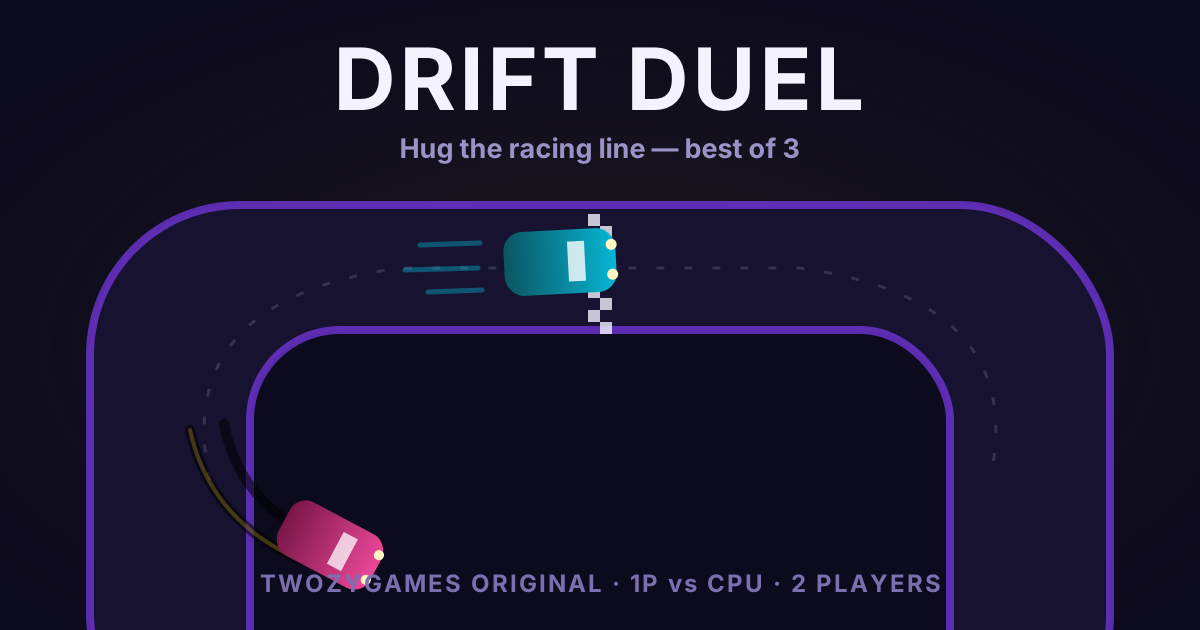 Guide
GuideDrift Duel Strategy Guide: Drift Physics, All 4 Stages and How to Beat Hard
The complete strategy guide to Drift Duel, written by the people who coded it: why steering is your only brake, the racing line that actually works, stage tactics for Circuit, Hourglass, Tri-Oval and Chicane, and how to out-drive the Hard CPU.
Read more →