Most lists of games for couples make one quiet mistake. They assume both of you play games. On a real couch that is rarely true. One of you has years of practice. The other last played something on a phone in a waiting room. Three rounds later, one of you is being polite about it. This list starts from the opposite idea. Most games here are either co-op, so you share one result, or turn-based, so fast hands do not decide the evening. We put the gentlest games first. The list ends with a few light duels, for when you are ready to compete.
Start here: games nobody loses
These three are cooperative. There is no winner and no loser, only a shared result on the screen. That takes the pressure out of the room.
 1–2PCasual
Quilt
No timer and no way to lose — just a board the two of you fill in together.
▶ Play NowQuilt is a board the two of you fill in together. Take turns placing tiles of your colour. Connected patches score their size squared, so the best move is often to leave your partner room. There is no timer and no way to lose. It is the calmest game we have made.
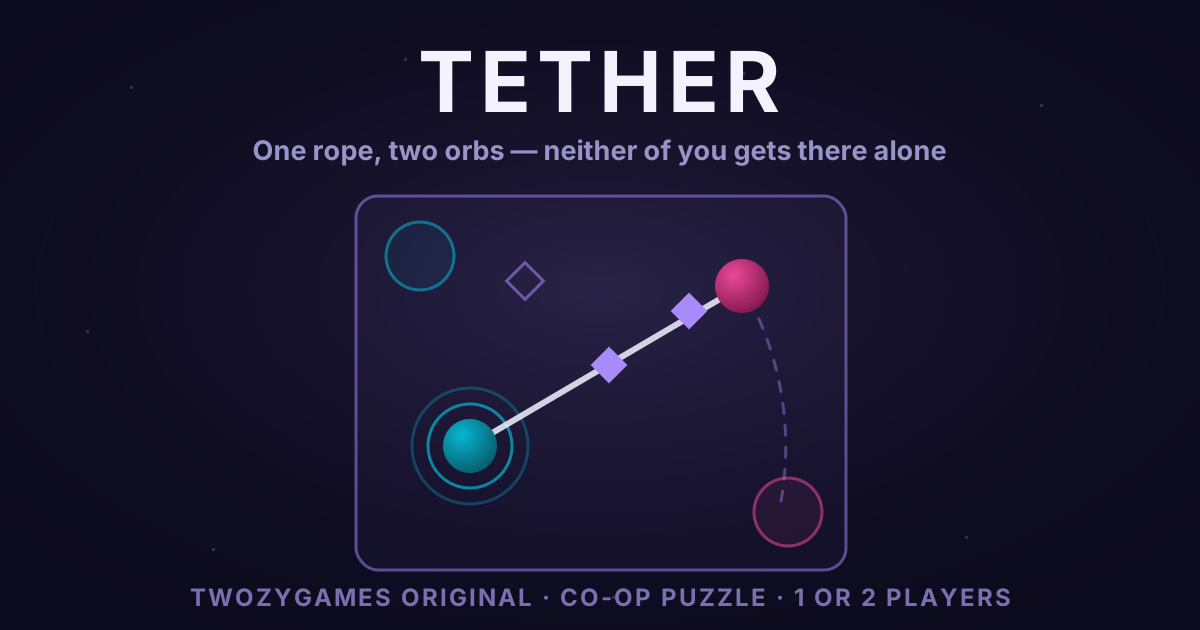
Tether ties two orbs together with a rope. A level only ends when both of you are on your pads at the same moment. Run for your own pad and you drag your partner off theirs. Every move becomes a small negotiation, and that is the whole charm.

Yoke gives you one body with two owners. You steer left and right. Your partner steers up and down. A diagonal is something you both have to say at once. Letting go of your axis is often the fastest way to the target.
Turn-based: no reflex gap
In these games only one person moves at a time. A slow thumb cannot lose a round. What decides them is reading, timing and nerve, and those are spread far more evenly between two people.
 1–2PCasual
Button
Closest stone to the button takes the end — and the last stone alternates.
▶ Play NowButton is flick curling. Drag back from your stone, let go, and a dotted line shows exactly where it stops. Closest to the centre takes the end. The last stone alternates every end, so nobody keeps an advantage.

Nerve is push-your-luck. Push the pot to add a point, or bank what is in it. The odds of losing the pot are printed on the screen. Forty points wins. It takes thirty seconds to learn and it gets loud.

Sleight is pairs with a shuffling board. Miss a match and three tiles slide to new places. A big memory is no longer a free win, because the board keeps spoiling what you remember. Attention decides it, and attention is a choice.
Light co-op from the catalogue
Kids Kitchen lets you run a virtual restaurant together. The publisher pitches it as collaboration and cooking fun, with several game modes to try. Do not be put off by the name.
When you are ready to compete

Penalty Kicks is a shootout where the kicker aims in plain sight. The keeper watches the crosshair until the instant of the kick. Five kicks a side, then sudden death. It is a bluffing game more than a sports game.
Volley Bean is a light volleyball duel. Short rallies and simple controls. The publisher says boosts spawn at random, so a beginner can still steal a point. Play a first-to-five series so no single game defines the night.
Soccer Duel is table football, one on one. It is played with the mouse, and the publisher says you can play it with a friend on the same device.
What usually does not work
For balance, here is what we would skip on a night in.
Rage-bait games. Anything where one of you spends twenty minutes angry at a missed input. Skill-gap fighters and twitch shooters live here. Even if you both like them alone, the win-lose framing leaks into the room.
Long story games. Multi-hour campaigns do not survive interruptions. The first phone call kills the session, and it never comes back. Couple gaming works better in five-minute units.
Games with a steep one-sided learning curve. If one of you grew up on fighting games, a deep fighter rewards that so heavily that the other person stops trying. Every game in the first two sections above was chosen to avoid exactly this.
Setting up your space
Pull the laptop forward so you can both see the screen at a similar angle. Keep snacks on the far side of the keyboard, not next to it. For same-keyboard play the laptop should sit flat. Skip the headphones. Speaker audio is part of the shared experience.
A few tips
Start with the co-op games before anything competitive. Keep rounds short so nobody feels stuck in a long match. A little trash talk is fine. Do not let a bad physics bounce turn into a real argument. Everything above is free on TwozyGames, with no download and no account. If you want the full list picked for the same reason, see our couples collection, or read how two people share one keyboard.