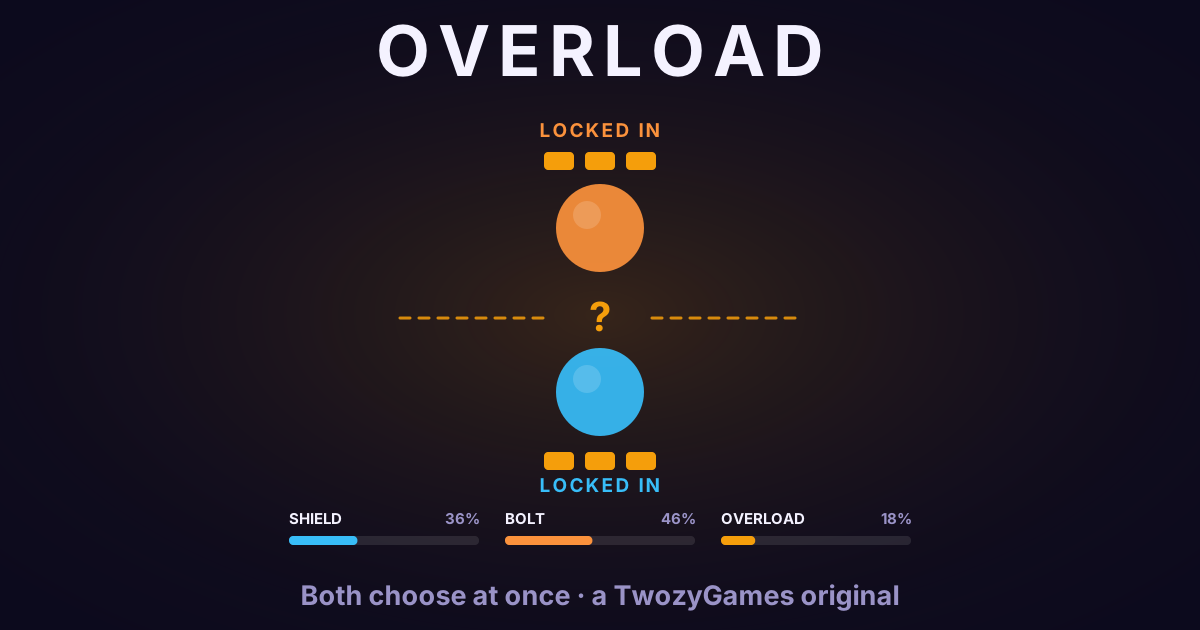
Overload is the only game in the TwozyGames Originals lineup where both players act at the same instant. You each lock one of four choices — charge, shield, bolt, or overload — while the other is locking theirs, and the exchange resolves the moment you have both committed. Neither of you can react, because there is nothing to react to until it is already over.
That raises an obvious objection, and it is the right one to raise. We will answer it with a number, then give you the actual solution to the game.
"Isn't this just rock-paper-scissors?"
It is a fair question, because rock-paper-scissors is the cautionary tale of this entire genre. Its optimal strategy is to pick completely at random, which means a perfect player beats someone flipping a coin exactly half the time. Skill cannot exist in it. Build a simultaneous game carelessly and you get that by accident.
So before writing a line of the game we solved candidate rule sets, and kept plain rock-paper-scissors in the simulator as a control that had to come out flat — if it ever looked deep, the measurement was broken.
The number that separates the two is how much the best mix changes from position to position. In rock-paper-scissors every situation is identical, so that number is 0.00. In Overload, comparing positions that offer the same four options, the best mix shifts by 0.83 on a zero-to-one scale. You still want to be unpredictable — but unpredictable in a way that fits the charge on the table, and that is a skill you can get better at.
The solved table
Here is the full equilibrium for every charge position, straight out of the solver. Rows are your charge, columns are theirs. Dashes are options you do not have.
| You vs them | CHARGE | SHIELD | BOLT | OVERLOAD |
|---|---|---|---|---|
| 0 vs 0 | 100% | 0% | — | — |
| 0 vs 1 | 51% | 49% | — | — |
| 0 vs 2 | 56% | 44% | — | — |
| 0 vs 3 | 70% | 30% | — | — |
| 1 vs 0 | 69% | 0% | 31% | — |
| 1 vs 1 | 27% | 57% | 16% | — |
| 1 vs 2 | 24% | 58% | 18% | — |
| 1 vs 3 | 31% | 38% | 32% | — |
| 2 vs 0 | 59% | 0% | 41% | — |
| 2 vs 1 | 21% | 54% | 25% | — |
| 2 vs 2 | 17% | 59% | 25% | — |
| 2 vs 3 | 26% | 33% | 41% | — |
| 3 vs 0 | 0% | 0% | 0% | 100% |
| 3 vs 1 | 0% | 52% | 22% | 27% |
| 3 vs 2 | 0% | 58% | 25% | 17% |
| 3 vs 3 | 0% | 36% | 46% | 18% |
Nobody expects you to memorise sixteen rows. The point of printing it is that the rows are visibly different — which is the whole argument of the section above, made concrete.
Three lines worth actually knowing
At 0 vs 3, do not shield
This is the line that feels wrong and is right. They are fully charged, you are empty, and every instinct says put up a shield. But at three charge they can spend the lot on an overload, which goes through a shield — the only thing in the game that does. So blocking buys you almost nothing, and the table says charge 70% of the time. You reload into the teeth of it, because the alternative is standing still while they pick the moment.
When you are armed and they are not, shielding is worthless
Look at the 1 vs 0 and 2 vs 0 rows: shield is 0% in both. They have nothing to shoot with, so a shield defends against nothing at all. Any exchange you spend shielding there is an exchange you did not spend charging or attacking. It is the most common beginner leak in the game.
Fully charged against fully charged is the real decision
3 vs 3 is the most genuinely mixed square on the board — shield 36, bolt 46, overload 18. Nothing dominates, and every option is live. If Overload has a signature moment, it is this one, and it is the reason the game shipped: a position where a thoughtful player and a careless one make visibly different choices.
Why two bolts cancel
Fire at the same instant and the two bolts cancel; you both lose the charge you spent and the duel carries on. This is deliberate, and it changes how you should feel about trading.
If simultaneous shots killed both players, rounds would end in a draw far more often and the whole thing would drift toward a coin toss. Because they cancel, trading is a real decision rather than a disaster — when you are both armed and both nervous, firing is often the calm move, not the reckless one. Two overloads cancel the same way.
The rule that stops the game being a stalemate
The first version of Overload had no overload in it, and it was dead on the table. Shielding costs nothing, so two competent players simply never have to commit. We measured it: two equilibrium players drew 99.3% of the time, rounds ran past fifty exchanges, and a three-line rule of "shield whenever they are armed" could not be beaten by an exact best response at all.
Adding a shield-piercing attack at full charge fixed it completely — no draws at all, five to eight exchanges per round. So the overload is not a bonus move bolted on for flavour. It is the thing that forces both of you to eventually put something on the line, and the three-exchange cost is what stops it being the answer to everything.
How to beat the Hard CPU
Hard plays very close to that solved table, and it never looks at your choice before committing. But there is a specific, exploitable reason it is beatable, and it is worth understanding.
Equilibrium play is maximin: it guarantees it cannot be taken advantage of, but it also does not punish you. It is not modelling your habits and it will never adjust to the fact that you shield every single time you are threatened. Against a strategy that never adapts, a human who deliberately skews — charging more against a shield-happy CPU, or holding bolts against one that trades — takes real value that the CPU will not take back.
For scale: an exact best response beats naive play by ninety points or more, while Hard beats a random player 67.9% of the time. That gap is not a weakness in the CPU, it is what "sound but non-exploiting" looks like. Playing soundly is a much better opponent to learn against than one that reads you.
If you liked this one
Overload is the second Strategy original, after Cannon Duel — the other game in the lineup where the decision matters more than the reflex, and the other one whose CPU was built to be honest rather than clairvoyant. The rest of the lineup is on the Originals hub, and our two-player picks cover the wider catalogue.