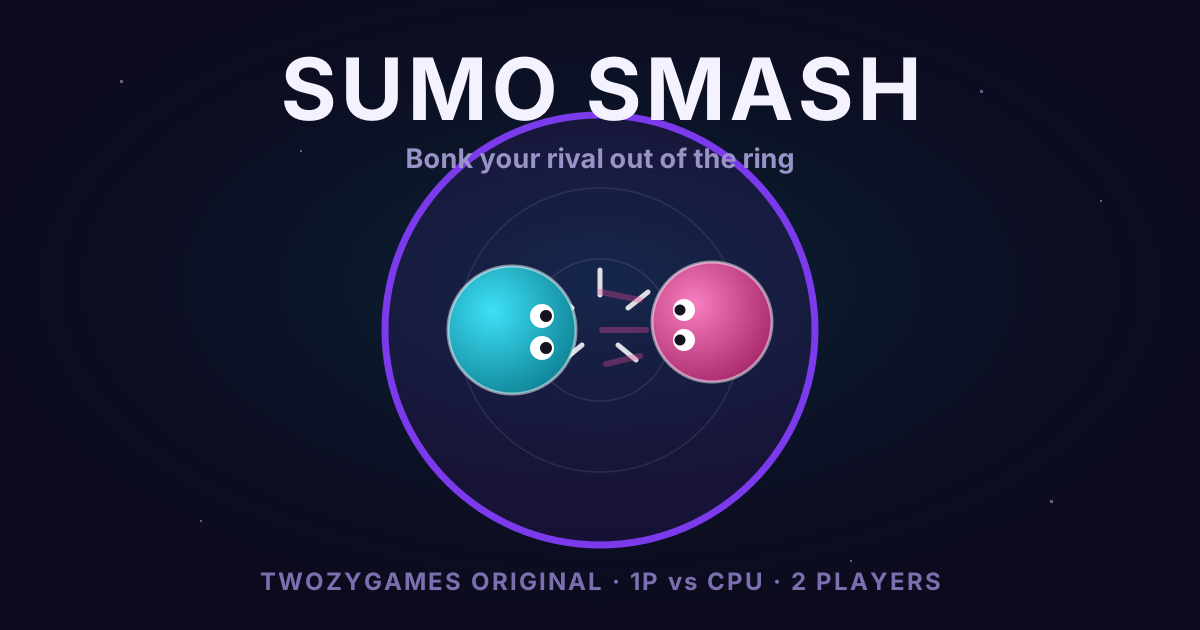
Sumo Smash is the most-played game in our TwozyGames Originals lineup, and it looks like the simplest: push the other sumo out of the ring, first to five rounds. But because we wrote every line of its physics engine, we can tell you exactly why you keep flying out of the ring — and exactly how to stop. This is the complete strategy guide: how the collision system really works, what each stage changes, and how to beat the Hard CPU without gambling.
The two physics rules that decide every round
Rule one: collisions are symmetric. Every impact bounces both sumos with the same energy — and the bounce is elastic enough that contact always sends both players moving apart faster than they came together. There is no such thing as a safe charge. If you hit your rival in the middle of the ring, you have accomplished nothing except moving both of you closer to some edge — possibly yours. Position first, contact second.
Rule two: the dash is a multiplier, not a movement tool. Dashing gives you a short burst of speed (about a fifth of a second), and while either player is mid-dash, collisions hit roughly 75% harder. That bonus is the entire offense of the game — a dash that connects launches your rival, while a normal shove just jostles them. But the dash has a cooldown of just under a second, shown by the white ring filling around your sumo. A whiffed dash means sliding, steerless, past your opponent with your one weapon spent. One more detail worth knowing: the game caps normal movement speed, but a dash briefly breaks that cap — which is why a well-timed dash connects even against a rival who is running away at full speed.
Core technique: fight for the center, strike along the exit line
- Claim the center early. The player nearer the middle can attack in any direction; the player near the edge can only defend inward. Most rounds are decided by this positioning before a single dash is thrown.
- Dash on contact, not on approach. Close the distance with normal movement, and press dash only in the last instant before impact. Early dashes are dodged; contact dashes connect at the full 1.75x bonus.
- Re-center after every exchange. The symmetric bounce means you drift after each hit. Steer back toward the middle before re-engaging — trading hits while you are edge-side is how winning positions collapse.
- Attack the angle, not the player. A hit only wins the round when it sends your rival across the boundary. Circle until the line from you through them points at the nearest edge, then commit.
Stage-by-stage strategy
Classic is the pure duel — everything above applies unmodified. Learn here.
Shrink closes the ring steadily down to about half its starting size. Early aggression is a trap: territory does the work for you, so take the center, play patient defense, and let the shrinking boundary turn your rival's small positioning mistakes into eliminations. The endgame ring is tiny — one clean contact dash usually ends it.
Bumpers drops two solid pillars into the arena. They block movement and bounce anyone who touches them, which effectively creates narrow lanes. Herd your opponent toward a pillar: a rival with a bumper at their back has nowhere to retreat, and a dash that squeezes them between you and the pillar almost always ricochets them somewhere bad.
Ice cuts the floor's grip dramatically — momentum that would normally die in a fraction of a second carries for much longer. Accelerate in short taps, never hold a direction, and treat every dash as a commitment you cannot cancel. The strongest Ice tactic is the sidestep: let an over-committed rival slide past you, then shove them out along the direction they were already traveling.
Beating Easy, Normal and Hard
The CPU plays by the same physics you do — it never gets extra speed or free dashes. The difficulties differ in reaction time, aiming noise, and discipline. Easy reacts slowly, wanders, and deliberately makes mistakes about one time in five; almost any center-control play beats it. Normal is tuned to be a genuine 50/50 against a casual player — it respects the edge and dashes with intent, so you win by re-centering more consistently than it does. Hard never makes an unforced error, guards the center jealously, moves at full speed, and saves its dash for the moment you are edge-side. You cannot out-mash it. Beat it by weaponizing its own discipline: feint toward the edge to bait its committed dash, sidestep, and hit it while its cooldown ring is still filling. On Shrink, Hard's center-hugging is actually exploitable — it will hold the middle even when you have the angle, so circle and strike along the exit line.
Winning the 2-player mind game
On one keyboard (P1 on WASD + Space, P2 on Arrow Keys + /), Sumo Smash becomes a bluffing contest, because both players can see each other's cooldown rings. That white ring is public information — attack the moment your rival spends their dash, and show restraint when yours is down. Fake approaches are the meta: step in to bait a defensive dash, back off, then punish the empty cooldown. If you enjoy this kind of same-screen standoff, our same-keyboard multiplayer guide collects every 2-player duel on the site, and the Originals tour covers the other games we built.
Quick reference
- First to 5 rounds wins · dash cooldown is just under a second (watch the white ring)
- Dashing collisions hit about 1.75x harder · all collisions bounce both players
- Stages: Classic · Shrink (ring closes to about 55%) · Bumpers (2 pillars) · Ice (low friction)
- Title screen: D cycles difficulty, S cycles stage · In match: P pause, R restart, Esc menu